 All projects
March 2026· Running on a Pi in my room
Real-Time Video Monitoring & Detection
An anomaly-detection model that runs on a Raspberry Pi and tells you whether the bed is made.
- Computer Vision
- PyTorch
- Anomalib
- OpenCV
- Raspberry Pi
- Edge ML
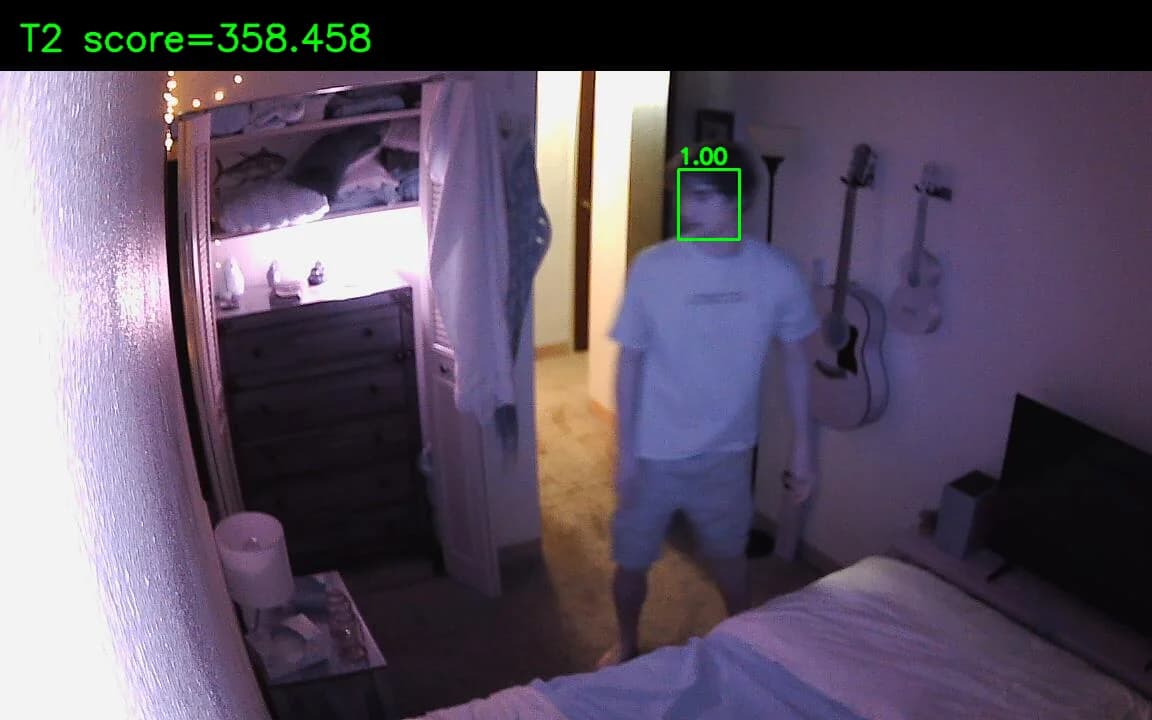
A real-time video pipeline that watches a live camera feed, finds what it cares about, and decides whether what it's looking at is normal.
It started as straightforward object detection — Haar Cascade classifiers over an OpenCV capture loop, with a lot of preprocessing tuning to get reliable hits under changing light. The interesting part came second: swapping "is there a thing here" for "does this look right," using PatchCore via Anomalib on top of PyTorch. The concrete test case was a bed. Made, or not made?
That turns out to be a genuinely good anomaly-detection problem. There's no clean bounding box to draw, the difference is textural, and "unmade" has infinite variations while "made" has only a few. So the model learns what made looks like and scores everything by how far it deviates.
Getting it onto a Pi
Training on a laptop is one thing; inference on a Raspberry Pi is another. The work there was:
- Collecting and labeling my own dataset, since nothing off the shelf covers this.
- Feature extraction and threshold calibration so the anomaly score maps onto an actual decision rather than a number nobody can interpret.
- Trimming the inference path to fit the Pi's memory and CPU budget.
- Encrypting the video stream in transit and at rest — it's a camera in a bedroom, so that isn't optional.
Structure
I split it into data ingestion, preprocessing, inference, and alerting as separate modules. That sounds like over-engineering for a personal project until you're three weeks in trying to work out whether a bad result came from the camera, the crop, or the model. Being able to test each stage on its own is what made it debuggable.
A later version added a two-run confirmation step: it only alerts when two consecutive checks agree, which killed nearly all of the false positives from someone just walking through frame.